This is my second time attending the Japanese Film Festival hosted by the Japan Foundation Manila. The first time I participated was in Q1 of 2024 while I was taking up elementary Japanese classes as my foreign language elective required by my course.
The opening film was Shunji Iwai’s Love Letter. Before the screening, there was a speech made by the director of the Japan Foundation Manila1 who states that “we could learn more about Japan without ever needing to visit Japan”. I thought this was an interesting statement. For one, I think you should be trying to promote tourism. Although Japan might already have more than enough of that, there’s still that sentiment that “films” are very different from “reality”. People who like to watch Japanese movies would likely want to visit and experience the real Japan. That’s when it hit me: the Japan that he was referring to isn’t “actually Japan” but rather the reconstruction of the image of Japan that exists only in our heads.
I have travelled to Tokyo toward the end of 2023 where I took over a thousand video clips using an old compact digital camera. Japan felt real to me because I was physically there. When I was at Hakone, I was able to see some of the sights, like Lake Ashi, that I first saw in Neon Genesis Evangelion. I saw the Akihabara that was in Steins;Gate. I saw Shibuya where the Phantom Thieves roamed.2 My point is, even though I’ve been to Japan, Japan still sits somewhere in between the image and the real. While I was flying back to the Philippines, I thought that I was returning back to reality and every moment in Japan was nothing short of fantasy preserved by my digital camera.
What I present here are my experiences watching the Japanese Film Festival 2025 lineup. The films here are in order of when I saw them except for Ghost in the Shell which I watched twice. Since it was also the last film I saw, I placed it at the last in this list. I wouldn’t necessarily call this a series of “film reviews”. Instead, I would like to describe them as my thoughts on each film. There are no numerical ratings – only my raw thoughts.
Love Letter (1995) #
Love Letter was the flagship and opening film of this year’s lineup. It’s a well-known movie among the Japanese cinema cinephile circles. As for me though, I was only attracted to it thanks to the director: Shunji Iwai. Not too long ago, I saw his other film All About Lily Chou-Chou while doing a little bit of research on enjou kousai films (such as Bounce Ko Gals and Love & Pop). All About Lily Chou-Chou is heavy, dark, and quite depressing to watch. It has this incredible atmosphere to it though which explores a specific kind of youthful violence in a way I’ve never seen before.
Love Letter is almost the polar opposite of Lily Chou-Chou. Unlike Lily Chou-Chou, it’s lighthearted and hopeful where the ending made the entire audience go “awww…” which is something I’ve never experienced whenever I went to the theaters. It starts off quite confusing when two characters share the same appearance (same actor) and another two characters share the same name. It took me a while to pick up and I was almost convinced this woman was having an identity crisis (after seeing Lily Chou-Chou, I wouldn’t be surprised if that was the case). This film is also quite atmospheric, being set in Hokkaido and all, but the cinematography, especially that of the opening scene, really sells it. It doesn’t evoke the strongest emotions out of me but that’s because the relationship of the two Itsuki Fujiis is so unique.
Having seen Lily Chou-Chou, it seems like Shunji Iwai is really interested in a particular kind of high school boy. This mysterious, gloomy, hates-the-world, indifferent, and apathetic kind of guy who borders the imaginary. A bit of a delinquent. You can see traces of the male Itsuki Fujii in Hasumi and especially Hoshino from Lily Chou-Chou but much more tamed.
I think the film is perfect to watch alone. The romantic approach might not be the most unique approach today (chasing after phantom boys, asking his “best friend” what he likes the most) but the relationship between the two Itsukis is one that could never be anymore. Considering the death of the male Itsuki, it’s impossible for their relationship to develop into anything more than two people in an awkward situation that made high school life annoyingly difficult. The entire situation is completely set up though so that male Itsuki has always loved female Itsuki. It puts the relationship in a stasis in which its development permanently lies on an artifact – male Itsuki’s love letter.
Very unfortunately, I missed the talk-back session during the last day of the UPFI run. It was 18x2 (discussed below) before Love Letter plus Shunji Iwai talk-back session. I had I’d be able to make it if I left the theater immediately once the credits started rolling it. The moment I stepped outside, the line for Love Letter reached all the way until the College of Music parking lot. I lined up, and by the time I reached the entrance of theater, it was already at max capacity. Looking back, I wish I told them I was a film student doing research on Shunji Iwai’s films. Perhaps they would have let me in if I begged.
Apparently, Love Letter has a sequel titled Last Letter which has Hideaki Anno part of the cast. I’ll have to check it out some day.
Spirited Away (2001) #
The first time I’ve seriously watched Spirited Away was in 2019 for my world religion class in high school. Obviously, the religion in question was Shintoism and while watching, we had to think exactly what about Shintoism was being expressed in the movie. In my case, I completely ignored most aspects about Shintoism and saw the very obvious signs of Marxism the moment Haku says that Chihiro must work in order to survive. This became a central topic in my high school essay for the film where I also took note of the scene where a spirit walks into the bath and is revealed to be a river guardian polluted with industrial waste. The reoccuring term in that paper was “Japanese industrialization” and “consumerism”, referring to my imagination of the rapidly industrializing Japan during the 1960s (I knew very little about the history of Japan at the time).
At the time, I believe it wasn’t a very popular interpretation of the film yet and most anglophonic analyses focused on the “growing up” of Chihiro as she experiences the fantastic world presented to us. Perhaps this thought was mostly influenced by the opening sequences where it is shown that Chihiro is moving and she refuses to accept her new life. Likewise, I also feel that much of the Marxist themes are completely lost, disappeared, or slowly faded away towards the second half of the film. After all, in cinematic Marxist tradition, there is often either a revolutionary ending to the film, a total annhilation of the individual, or the never-ending pushing of boulders up the mountain. Just like the first time I’ve seen the film, it seems like I’ve forgotten what happened in the second half the second time.
Despite that, I don’t think the disappearance of Marxism in the end is a critique of Spirited Away (unless you’re a full-blown Marxist I guess). I still find it very difficult to understand what Miyazaki wants to say about Spirited Away in the latter half. Perhaps the anglophonic interpretations of Chihiro’s maturity is correct after all.
Evil Does Not Exist (2023) #
I came in partially blind on this one. The opening shot was the camera facing upward as it ventures through a snowy forest. The words “EVIL DOES NOT EXIST” flash on the screen with some flashing omissions of the words “DOES NOT”. To some degree, I already had a good feeling that this was going to be a class struggle film of sorts. With a title seemingly as radical as this, it just had to be. Takumi was seemingly obsessed with the words of the village chief who expresses that water flows downhill, and the decisions of the people above greatly impact the people below.
Social realist? Magic realism, maybe. Everyone came out of the theater confused. Even I thought that I missed an important scene or line of dialogue at the end. You might have at some point in the middle. While Takumi was driving the two talent agency representatives, Takahashi and Mayuzumi, he mentions that deer are very timid creatures and don’t harm people except if they were “gut-shot” and “could not run”, in which case, they might fight back.
When Takumi and Takahashi finally find Hana, who appears to be observing a gut-shot deer, Takumi strangles and kills Takahashi. The deer are gone, what is left is a dying Hana, blood running down her nose. Perhaps quite a radical film for something I thought might not be so radical anymore when the representatives wished to learn more about Takumi’s society. The fate of Mayuzumi is left unknown, so is the fate of Hana.
In any case, this felt like an anti-PR film. I recall that there are quite a number of city or town PR films to boost tourism in Japan (see Let’s Go, Ishikawa!!). Evil Does Not Exist aestheticizes its fictional village, creating a serene landscape subjected to the outsider’s gaze but resists any opportunity to commodify it. After all, the village doesn’t even exist.
Does evil exist? I don’t know. I often get confused by the title and refer to this film as “Evil Does (Not) Exist”, but I personally blame the Evangelion brainrot.
The Boy and the Dog (2025) #
I don’t think there’s much to talk about for The Boy and the Dog. It was probably the only film that made me cry in this lineup but that’s partially because we lost our dogs, Tiger and Caravaggio, earlier this year. It was really emotionally convincing even though I was expecting a bit more toward the end. I was really expecting that, after Kazumasa dies and becomes the guardian spirit of Tamon, Tamon would continue finding broken people and give meaning to their lives as he ventures his almost-a-decade-long journey. The only other person he encounters was the dying hunter. Miwa’s schizophrenia does stay in line with the overarching theme of this year’s lineup though.
Teasing Master Takagi-San (2024) #
It’s a bit strange to say but I feel like there’s a lot to talk about Teasing Master Takagi-San, the live-action adaptation of the anime/manga (and sequel of the live-action adaptation) set far past the events of the original.
It’s surreal to see Nishikata in live-action watching anime when the film itself comes from the exact medium he’s watching. Moving from anime to live-action has, to some extent, matured Nishikita, following the thought that anime is for children. Speaking of youth, the ending drags out, just as Takagi-san, its reincarnations, and its predecessors, drag out youthful love. By “dragging out”, I mean, it values this exact kind of relationship that ends when the two are “officially together”, or when the two are wedded. There was a scene somewhere in the movie where both Nishikata and Takagi attend a wedding. The bride complains that her groom never really proposed properly. There’s a not-so-rose-colored depiction of marriage here that both Nishikata and Takagi find themselves in. Takagi later explains to a student that she believes her noncommittal relationship with Nishikata is deeper than love. At this point, I’ve already forgotten what her philosophy was. Despite that, the film concludes with them being together anyway.
What’s interesting about watching this movie in the cinema, which otherwise won’t ever happen if you watched it alone on your phone at home or in the bus ride going home, is that you get to watch the audience as well. Forget about the movie. There are literally people pulling up their phones to record Nishikata’s confession to Takagi. What’s funny is that the scene drags out for so long that people would have to keep redoing the recording. For some reason, other people prefer to watch the movie through the lens of their palm-sized phones.
There are two explanations for this. For one, the anti-piracy law is weakly enforced in the cinema. I do remember during last year’s JFF, some of the staff went up to people who were taking photos asking them to delete it. This year, nobody actually seemed to bother trying to enforce the rules. For the second explanation, Filipinos are just naturally inclined to post everything to social media. Gotta put something in the Instragram story. How about a clip from this movie? I doubt they aren’t aware that it’s still technically a crime even if all you did was snap a photo of the title card or the end credits. Nobody seems to care anyway, and its free marketing for the production team.
If there’s anything I enjoy about cheesy romance films like this, it’s having a huge reactive Filipino audience. Somebody needs to put a camera in front of the audience because the audience is just as entertaining than the film. Probably more entertaining. Non-Filipino readers, I can’t explain this to you better. The word kilig has a certain sound attached to it. One must watch a cheesy romance film with a Filipino audience at least once in their life to understand.
Showtime 7 (2025) #
Apparently, this is based off (or a remake?) of a 2013 Korean film titled “The Terror Live” but reading the Wikipedia entry (of the Korean film) shows that Showtime 7 deviated a bit. In Showtime 7, the terrorist doesn’t actually kill anyone nor has he seemingly ever had the intention to kill.
Really, what Showtime 7 is about is the media. Terrorism goes well together with the media. In fact, if I’m not mistaken, terrorism is understood as trying to get the most attention possible through violent means. Media coverage is very important for terrorists, and the media not covering terrorism somehow defeats the purpose of terrorism. Thinking about this, perhaps this is why Baudrillard seems so interested in terrorism, but I’ll have to read through it a bit more.
The central thesis of the film is that media practitioners who act as the fourth estate are just as responsible for injustices committed by corporate leaders and politicians. The terrorist, Shigefuji Kanji, shifts the blame of his father’s death from the CEO to the prime minister of Japan, then to the popular news anchor, Shinnosuke Orimoto who, several years prior, decided not to air the interview with Shigefuji’s mother in order to secure his spot in NJB (the news company he used to work for). The film essentially exposes how the media is in kahoots with both corporations and the government, and how the promises of the media to deliver fairness and justice is completely fabricated for capital gain. One just has to make the public feel like they’re being told the truth.
Where the film gets confusing is when Orimoto puts up a poll: should Orimoto live or die? It’s not directly shown to the audience what the poll results are but we can assume that most people voted “die”, seeing an out-of-focus screen in the background showing red (die) as the dominant choice, as well as Orimoto pressing the trigger to blow himself (and the entire studio) up. Nobody, not the SWAT (SAT? JSDF?) nor the broadcasting team try to stop Orimoto from blowing the entire place up. Without overreading, I’ll just assume that Orimito’s “death” was nothing but his own fantasy of salvation, but can he really be saved? As he pushes the detonator button, it just cuts to a shot of the city. This is followed by the images of mobile phones, televisions, radio broadcasts, and all the digital media that mediates the city. To close the film, a music video for “Human Factory” by Perfume plays side-by-side with the end credits.
Did we just forget the sensational events that played before us? Perhaps so. Orimoto mentions that television is nothing but performance. He even delivers this speech as the screen (albeit inconsistently) appears to be as if the audience was watching the live broadcast itself. He even refers to the events as “the past two hours”, which may align with the diegetic world but it definitely aligns with our world – we are watching a movie. He’s breaking the fourth wall here. Showtime 7 is self-aware that its message on corruption, accountability, greed, and all the evils of capitalism is something to be taken advantage of to produce big bucks. It consumes itself. It’s 100% fatal.
Mobile Suit Gundam SEED Freedom (2024) #
Prior to watching this, I was just listening to Oshii Mamoru say that in becoming a film director, one must watch bad films.
I have to admit, I have never seen Gundam Seed so I can’t judge this too harshly but my favorite scenes include:
- “I can’t read his mind! … IS HE EVEN THINKING?!”
- “Docking.” Ass shot of Lacus
- “Why are you having dirty thoughts in a sacred battlefield?!”
The applause from the audience at the end was not because we learned that racism is bad. Rather, we all started clapping when we realized that the fan service was too funny to take the film seriously.
Absolute cinema.
A Samurai in Time (2024) #
The end of jidaigeki? If jidaigeki is the mythologizing of the samurai, then A Samurai in Time is the mythologizing of jidaigeki. This film literally consumes itself the moment the audience witnesses Kosaka kill Kazami which turns out to be the final cut of the film they were creating as the diegetic audience watches. It could be read as some kind of death and revival of the jidaigeki seeing that Kazami is the old star of jidaigeki while Kosaka is the rebirth. Although the film never really “rebirths” jidaigeki, it recognizes itself as an artifact in time just as the way of the samurai is also an artifact in time.
Any Filipino filmgoer should recognize the parallels between jidaigeki and the Spanish colonial period historical films (think of any Artikulo Uno films produced over the past decade). Although we often use real actual events of the Spanish colonial period, jidaigeki also refers to the reality of the times but many of its micro-stories are fictional. Jidaigeki was quite ahead by capitalizing on this demand for preserving the Edo period as an artifact that is film. It was so ahead though that jidaigeki is on its deathbed. On the other hand, Philippine cinema still survives much of the Spanish colonial period historical films. Just recently, they made one on Manuel Quezon but the well will eventually dry up, and we’ll have A Rizal in Time very soon (actually, it might already exist as Maria Clara at Ibarra).
The point is, and as shown in A Samurai in Time, the events of the past are no longer real. Kosaka is still so sentimental of the past. He still cries out for the massacre of his people while Kazami doesn’t really seem to care anymore. The events of history did happen but over time, they are reduced to spectacles enjoyed on screen. It might not seem to matter to us today, but after a century, the events of today will be mythologized.
18x2 Beyond Youthful Days (2024) #
What made 18x2 very difficult to watch for me was the creaking seat that didn’t feel aligned properly, so my knees were practically floating. My ass was in pain, and I was afraid the chair was going to collapse soon. I’m not even a heavy person. I only weigh just under 60kg. On top of that, there was the anxiety that I was going to miss the Shunji Iwai talk-back session for Love Letter (which I did).
What’s surreal about this film though is that it directly references Love Letter. Jimmy and Ami go into the cinemas and watch Love Letter. 18 years later, Jimmy visits Niigata and yells 「お元気ですか」 and recommends the movie to some zoomer he comes across. To some degree, I think 18x2 is a reversal of Love Letter. Instead of a girl chasing after the phantom of a dead boy, it’s a boy chasing after the phantom of a dead girl. The revealing of their deaths are also reversed: it is in the beginning for Love Letter, and it is in the end for 18x2. Instead of seeing just Hokkaido, the many settings of 18x2 makes us feel like we’re also travelers: we visit Tainan, Nagano, Niigata, and Fukushima.
Unfortunately, there’s something about 18x2 that doesn’t pull out the feelings from the audience. While I was walking out of the cinema, I could hear a girl explaining to her friend that while she thought the movie was good, it felt like a story we all already knew. That might just be it, but I also feel like that the small intimate moments of the film just don’t feel intimate enough. Perhaps a relationship like this was too real and having the film play just before Love Letter puts it in a dangerous position of becoming a forgotten derivative of Love Letter.
Ghost in the Shell (1995) #
Earlier this year, I saw Ghost in the Shell for my Japanese literature class. You can read more about it here. The gist of the class discussion is bridging – putting zero and one together, putting A and B together. I apologize to all the philosophy majors for calling this Hegelian dialectics but can we just leave it at that until I actually study Hegel? I’m too busy studying Baudrillard at the moment.
On the second viewing, I could definitely feel the 90-minute run time. The film suddenly feels a lot shorter than my initial viewing. It’s either because I was thinking too analytically the first time, or I understood the film already the second time. Perhaps both. I was a bit disappointed that the audience number was very low. To be fair, it screened during a late-morning Monday and Cineadarna was mostly empty during the weekdays especially during the daytime. You can really feel the confusion in the audience when nobody wanted to applaud at the end (for some reason, I don’t ever remember applauding as a common thing to do in the movie theaters prior to the COVID-19 pandemic but it seems more common nowadays). It was a very weak and awkward applause. Maybe it was just because only a few dozen people attended.
The third viewing was interesting, there was a child behind me. Perhaps only around 7 years old. She was with her mother (or maybe her aunt?). Her mother told her that if she had any questions about the movie, she could ask her later. She also said she had never seen Ghost in the Shell but only reassured her child that “it’s an anime”. I thought this was crazy. For one, there were no age ratings for the films being played during the Japanese Film Festival, so nobody would know that this “anime” is for adults without further research. There is gore and full nudity. At least this child was a girl so seeing a completely naked adult woman might not be new to her by any means. But it could be gore-y at times, and overall, the film just isn’t something fun to watch for a child. That’s what Spirited Away is for (but please don’t ever send a child to watch Mobile Suite Gundam SEED Freedom). When the film ended, the mother asked her child what she thought of the film. The child said, “Incomplete.” I was taken aback. How could a child possible think this film is incomplete? It is a valid response from an adult, but for a child, I was expecting she’d think the film was confusing or boring. She continued and said that the film “felt like a short film”. This blew me away. A child in this day and age where TikTok and Instagram 30-second videos are the norm for entertainment thinks that 90-minutes of puppets talking to each other is incomplete? This child has restored my hope for this generation.
Setting that aside, there aren’t any new insights for Ghost in the Shell for me. I was happy that I could appreciate this film further and indulge in the ambience and the atmosphere this time rather than thinking of writing a 1000-word essay due a week later (instead, I am writing a 4000-word essay due a few days later). Within the festival context however, I think Ghost in the Shell perfectly captures that bridging of the real and the image. High school boys, dying girls, samurai, terrorism, giant robots, dream worlds, cinema itself – it all borders on the real and the image. You don’t ever have to visit Japan because either way, the experience of being in Japan and watching Japanese cinema is pretty much the same thing as far as the image is concerned.
JFF 2025 Goodies #
These are some of the goodies you get for watching at the Japanese Film Festival.
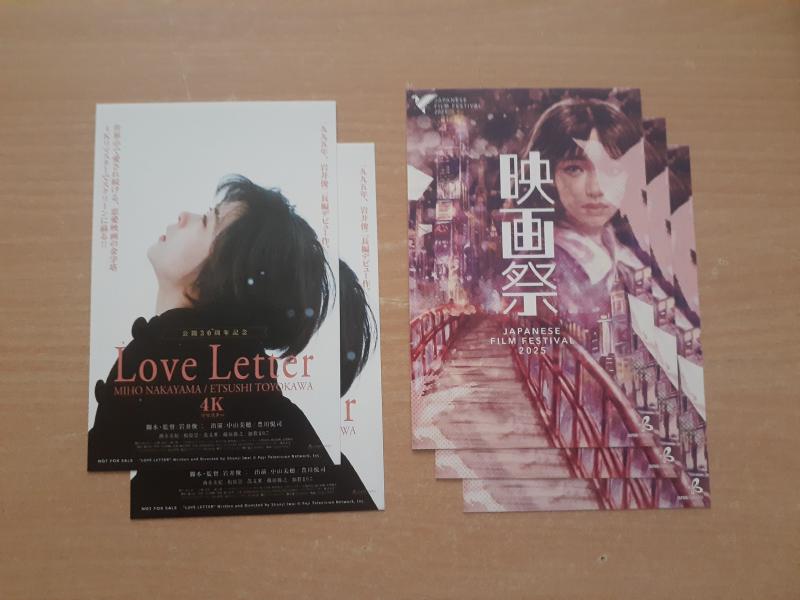
These are the two postcards given out for answering the post-screening survey. The Love Letter postcard is exclusive to Love Letter screenings and I hope that for future JFF runs, we continue getting these exclusive postcards. I was able to get another one from the last Ghost in the Shell screening, likely because they were just trying to get rid of it.

These are some stickers, a fan, and a magazine. The stickers are given to those who make a JFF account and join the per-screening raffle. The raffle prize is a t-shirt which I never won. The fan and the magazine was given while waiting for the final screening of Ghost in the Shell.
Closing Thoughts #
The only two films I did not have the opportunity to watch was Cells At Work! and Seven Samurai. While my schedule could accommodate the films, Seven Samurai is a three hour long film and they often slotted it for 7 PM which meant there was a good chance I would sleep half way. On the other hand, I missed the Cells At Work! screening because I would have been late by at least 10 minutes as I was coming from class. In hindsight, I think I wouldn’t have missed out on much as the films have been starting a bit later than expected. The final Ghost in the Shell screening was delayed up to around 40 minutes.
I feel like that the selection this year is a lot more memorable than last year. Last year’s highlight for me was We Made a Beautiful Bouquet which I liked more than 18x2. Not Quite Dead Yet was also more enjoyable than this year’s comedy film, A Samurai in Time. For the suspense-thrillers, I equally liked A Man and Showtime 7. Cheesy romance films are cheesy romance films. I preferred the atmosphere of Evil Does (Not) Exist over the experience of Angry Son. But last year’s animation selections are nothing compared to this year’s with two timeless classics. To be fair, Voltes V: The Liberation was at least worth my time unlike Lacus’ ass shots. We need The End of Evangelion next year, Ben Suzuki.
It might just be pure coincidence, but some of the films here share something in common in relation to the opening speech. Having Love Letter the opening film and Ghost in the Shell the closing film to be screened for the UPFI run says a lot. Even though some of the films never really deal with it (Takagi-San and Gundam SEED Freedom for example), they can still evoke that feeling when you’re with a public audience.
Additional Scans #
Before I throw these out, I thought it would be a good idea to scan these and put them here in case anyone in the future might find them useful.
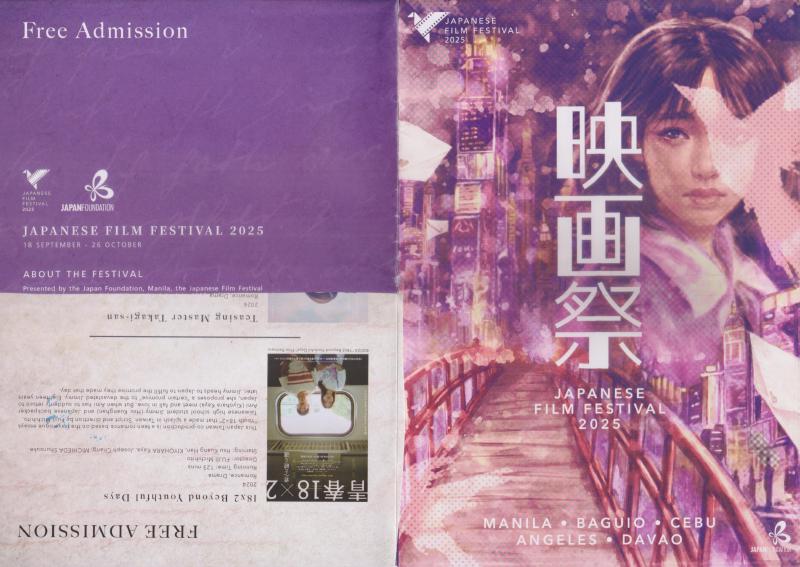
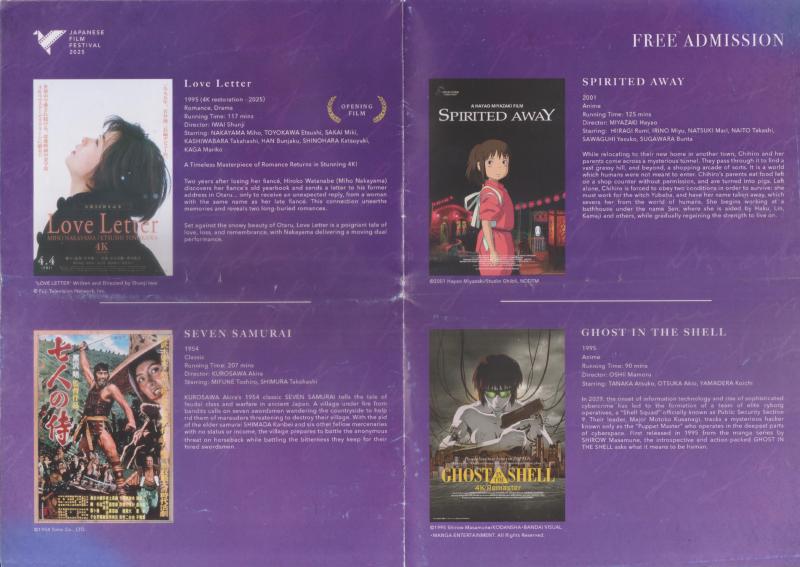
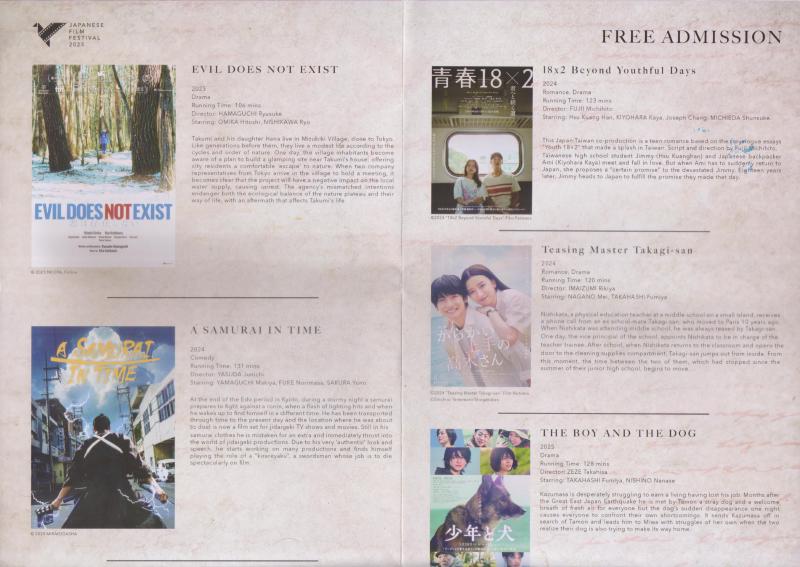
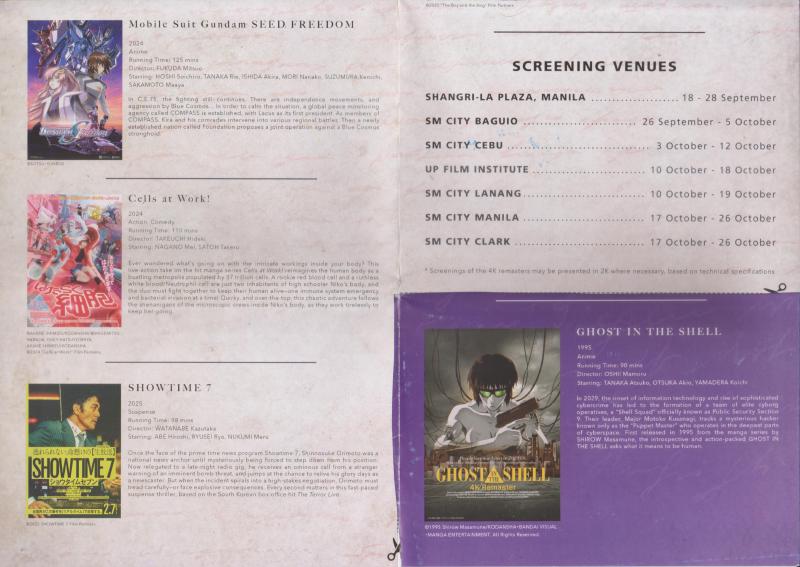

this section was added on December 23, 2025
-
I don’t remember his name nor his title. I tried looking it up but all I got was Ben Suzuki who looks completely different. Suzuki was there though during the talk-back session with Shunji Iwai and so was the guy who delivered the speech. ↩︎
-
This is a lie. I only played Persona 5 Royal earlier this year. ↩︎