The history of animation has always been ambiguous. It doesn’t have a clearcut definition of a beginning. This is true, provided that “animation is understood to be the inputting of life, or the inputting of the illusion of life, into that which is flat or inert or a model or an image“ (Leslie 28). With such an understanding of animation, its origins are endless: “zoetropes, zoopraxiscopes, shadow theater, flip-books” (Leslie 35) and possibly even joruri. This ambiguity is understood by Japanese scholars such as Yukimura who states that “[i]t is not clear whether traditional arts such as emaki, joruri, and kabuki are actually the origin of animation or not” (76). Regardless, Yukimura sees a close relationship between the two:
Since a doll of Joruri is puppeteered by the limited fingertip, their performance is patterned. In the case of animation, many pictures are needed and are drawn by animators to express animation figures. Animation also expresses the simplified form for reduction in labor required for each picture. (76)
In the case of Chikamatsu Monzaemon’s Sonezaki Shinju and Oshii Mamoru’s Ghost in the Shell, we also see a close, almost direct relationship between the two. Both Sonezaki Shinju and Ghost in the Shell use animated bodies (puppets and cyborgs) to make sense of an afterlife (Buddhahood and the net). However, what’s most interesting about the comparison is that the medium of Ghost in the Shell adds a second layer to what we understand as animated bodies: that is animation itself. In Sonezaki Shinju, Tokubei and Ohatsu share a climactic moment of committing a double suicide with references to Buddhahood, which at the time would have been considered a popular notion of transcendence. According to Bolton (763), “in the puppet theater, death is not only a consequence of these social pressures but also in some sense a willing transformation that reconciles individual volition with these social roles and expectations”. We see this during the exchanges between Tokubei and Ohatsu in act three. Particularly in Tokubei’s declaration: “now we hurry towards our end, hoping instead our two souls will find the same dwelling”. This shows how the lovers willingly embrace their suicide not as an escape, but as transformation rather. In the stylized medium of joruri, this transformation is portrayed through the puppets’ mechanical movements and the voice of the chanter.
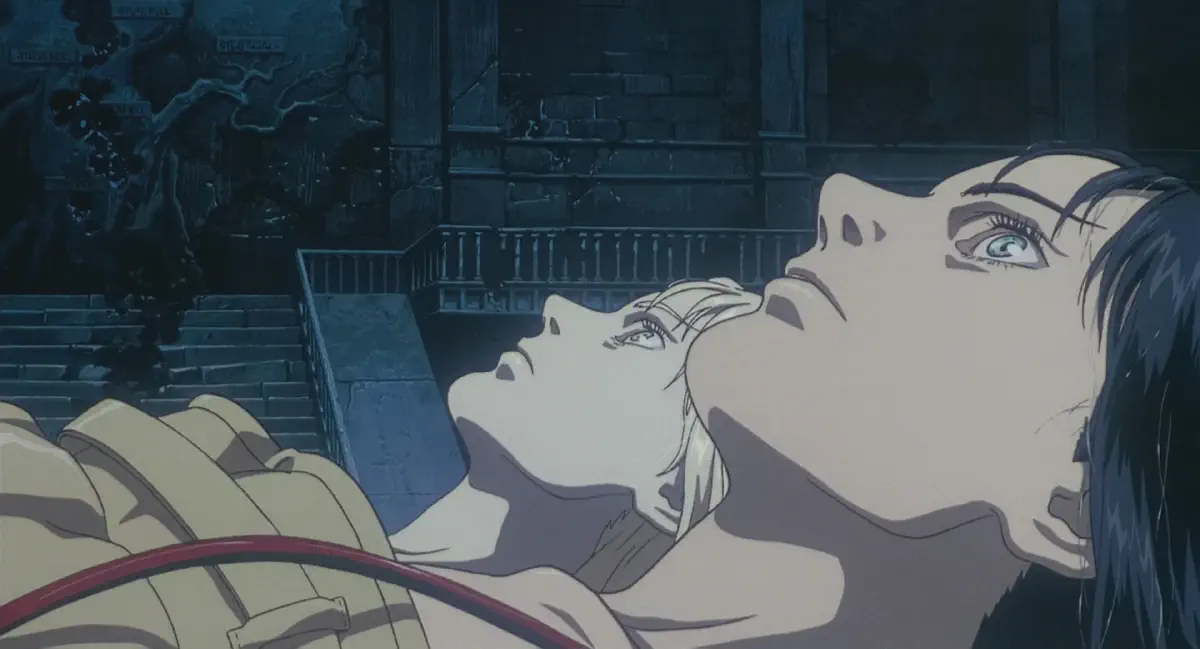
In Ghost in the Shell on the other hand, the final scene featuring Major Kusanagi and the Puppet Master merging into one can be read similarly: it is a unification of two bodies, albeit female bodies with one possessing a male voice. It also references religion but this time in the form of Christian and Jewish references, particularly the Tree of Life, the numerous references to 1 Corinthians 13, and the descending angel. Where Ghost in the Shell moves further than Sonezaki Shinju is that it doesn’t end with the death of two bodies with the promise of transformation. After the climactic scene in Ghost in the Shell, we see Major Kusanagi now take the form of a child-like doll body, contrasting her previously hypersexualized adult body. All of these events are rendered and portrayed through the medium of both drawn and computer animation.
Comparing these similarities and differences or parallels between joruri and Ghost in the Shell has already been done by Bolton in From wooden cyborgs to celluloid souls: Mechanical bodies in anime and Japanese puppet theater. To briefly summarize, the female bodies possessing male voices are presented in both (Bolton 762), the presence of religion (Bolton 759), even comparing violence in both (Bolton 759). In light of this, I would like to return to the narrative difference of the two: the aftermath of Ghost in the Shell wherein rebirth or transcendence is materialized both through “Little Kusanagi” and the addition of the scene itself as Little Kusanagi wonders where to go next. This shows a transformation that is no longer just symbolic, but fully visible and material.
Unlike in Sonezaki Shinju that ends in death and leaves rebirth to the imagination, Ghost in the Shell shows that transformation directly. Interestingly, it does so using a mix of cel animation and digital animation. This mixing reflects the major themes of the narrative itself: a fusion of old and new, analog and digital, human and machine. The film becomes a product of its own time, during a moment when animation was shifting from hand-drawn techniques to computer-aided ones. It’s not just telling a story about transformation. It’s showing what that transformation looks like through its own changing form.
What’s even more interesting, though, is that even with all this new technology, the film doesn’t move only forward. There’s also a sense of going back. The Puppet Master, as an immortal sentient program (or artificial intelligence, however you may like to describe it) rejects immortality. Choosing to give up immortality is, in one way or another, a return to being human. The new body that appears after the merge, Little Kusanagi, is also part of this. It looks innocent, perhaps even unfinished, compared to her adult body. This isn’t just a physical change, it also suggests a reset, a return to a beginning.
The film also uses visual imagery to support this return. In the climax, the scene takes place in an abandoned building that resembles the images of Oshii’s previous work “Angel’s Egg”. These fossils may as well represent the beginning of time, impermanence, death, but at the same time, seemingly immortality. The past is not erased by the future, it’s “carried forward” into it. I then return to the beginning of the essay where I argue that the history of animation is ambiguous. In a similar manner, while it may be clear that the change between the materiality of puppets and cel or digital animation signals progression, the many parallels between joruri and Ghost in the Shell might suggest that “movement” or “progression” between ancient and modern or life and death, doesn’t necessarily mean a complete abandon of “the previous”.
Works Cited #
- Bolton, Christopher A. “From Wooden Cyborgs to Celluloid Souls: Mechanical Bodies in Anime and Japanese Puppet Theater.” Positions: East Asia Cultures Critique, vol. 10, no. 3, 2002, pp. 729–71.
- Leslie, Esther. “Animation and History.” Animating Film Theory, edited by Karen Beckman, Duke University Press, 2014, pp. 25–36. JSTOR, https://doi.org/10.2307/j.ctv11sn1f6.5.
- Yukimura, Mayumi. “How Was Anime Institutionalized?” 関西学院大学社会学部紀要, 2013. Google Scholar, https://core.ac.uk/download/pdf/143632977.pdf.
Notes #
This article was originally submitted as a class paper for Comparative Literature 145 (Japanese Literature) under Professor Catherine Regina Borlaza. I unconsciously did not give the original paper a title, but in hindsight, I think it’s fitting considering the theme and the conclusion.